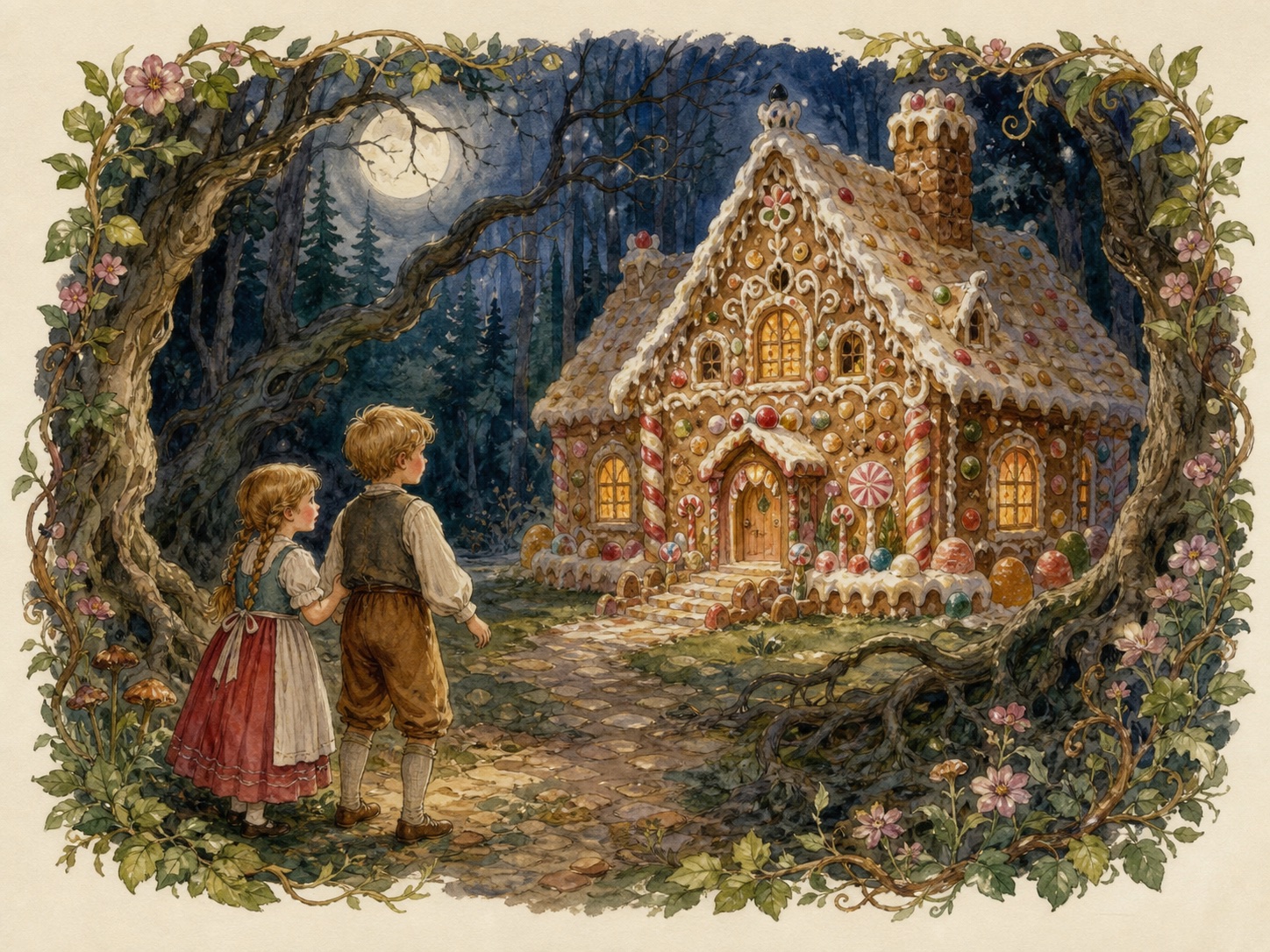
Hansel and Gretel
Brothers Grimm · faithful family retelling
At the edge of a great forest lived a poor woodcutter with his two children, Hansel and Gretel, and their stepmother. Food had become so scarce that one evening there was scarcely a crust left in the house.
“There is not enough for four,” the woman told her husband. “Tomorrow we must take the children deep into the forest, give them each a piece of bread, make a fire, and leave them there. Otherwise we shall all starve.”
The father was horrified. “Wild beasts will tear them apart.”
But his wife argued until grief and hunger overcame him. In the next room, the children heard every word. Gretel wept, but Hansel whispered, “Do not fear. I will find a way home.”
When the adults slept, Hansel crept outside. Moonlight shone on the white pebbles before the cottage, and he filled his pockets with them.
At dawn the woman gave each child a small piece of bread, warning them not to eat it before noon. As the family walked into the forest, Hansel kept stopping to look back.
“Why do you lag behind?” his father asked.
“I am looking at my white kitten on the roof,” Hansel said. But he was dropping the bright pebbles one by one along the path.
Deep in the woods, the father made a fire. “Rest here,” he said. “We are going to cut wood nearby.” The children heard an axe striking long after the adults had gone, but the sound came from a branch their father had tied to a tree so the wind would beat it against the trunk.
Night fell. Gretel cried, but Hansel waited until the moon rose. Then the pebbles gleamed like new coins, and the children followed them safely home.
The father rejoiced to see them. Their stepmother did not. Before long the famine worsened, and again the children heard her insist that they be taken away—this time farther than before. She locked the door, so Hansel could gather no stones.
The next morning he crumbled his bread in his pocket and scattered the crumbs along the path. Once more the children were left beside a fire. Once more the false axe knocked until evening.
But when the moon rose, there was no shining trail. Birds had eaten every crumb.
For three days Hansel and Gretel wandered. They drank from clear streams and slept beneath trees, but found no path home. On the third morning they saw a snow-white bird. Its song was so beautiful that they followed it until they came to a little house made of bread, with a roof of cake and windows of clear sugar.
“We shall have a feast,” said Hansel. He broke a piece from the roof while Gretel tasted a windowpane.
A thin voice called from inside, “Nibble, nibble, little mouse—who is nibbling at my house?”
The children answered, “Only the wind,” and went on eating.
An old woman came out leaning on a stick. “Dear children,” she said sweetly, “come inside. No harm shall come to you.” She served pancakes, milk, apples, and nuts, then tucked them into two clean beds.
But the old woman was a witch. She had built the house to lure children, for she had dim eyes but a keen nose and could smell a child from far away.
At dawn she seized Hansel and locked him in a barred stall. Then she shook Gretel awake. “Cook something good for your brother. When he is fat, I shall eat him.”
Each morning the witch ordered Hansel to put out his finger so she could feel whether he had grown plump. Hansel held out a little bone he had found in the stall. Because the witch could not see well, she mistook it for his finger and wondered why he remained so thin.
After four weeks she lost patience. “Thin or fat, tomorrow I shall cook him.” She ordered Gretel to fill the great kettle, then bent before the oven. “Crawl in and see whether it is hot enough.”
Gretel understood that the witch meant to bake her first. “I do not know how,” she said. “Where do I get in?”
“Stupid child! The opening is large enough. Look—I could get in myself.”
The witch thrust her head and shoulders into the oven. Gretel gave her one mighty push, slammed the iron door, and fastened it. The witch shrieked, but Gretel did not open the door.
She ran to Hansel, broke the lock, and cried, “We are free!” Together they searched the witch’s house and found chests filled with pearls and precious stones. They filled their pockets.
After walking for hours, they reached a broad stretch of water. A white duck carried them across one at a time. Beyond it the forest became familiar, and at last they saw their father’s cottage.
The woodcutter had known no happiness since leaving them. Their stepmother was dead, and he had mourned his children every day. Hansel and Gretel ran into his arms, then poured the jewels onto the table. Hunger and fear were ended, and the three lived together in peace.
About the old story: In the first Grimm printing, the woman is the children’s mother; later editions call her their stepmother. The witch is burned in her own oven, and the children return with her treasure. Those hard edges belong to the tale.