Unit · The Weekdays & Planets
The Weekdays & Planets
Seven days, seven lights in the sky, seven colors and moods — the oldest rhythm a child can live in.
This is the key to the whole weekly rhythm. Teach it once, then live it every week.
Aim
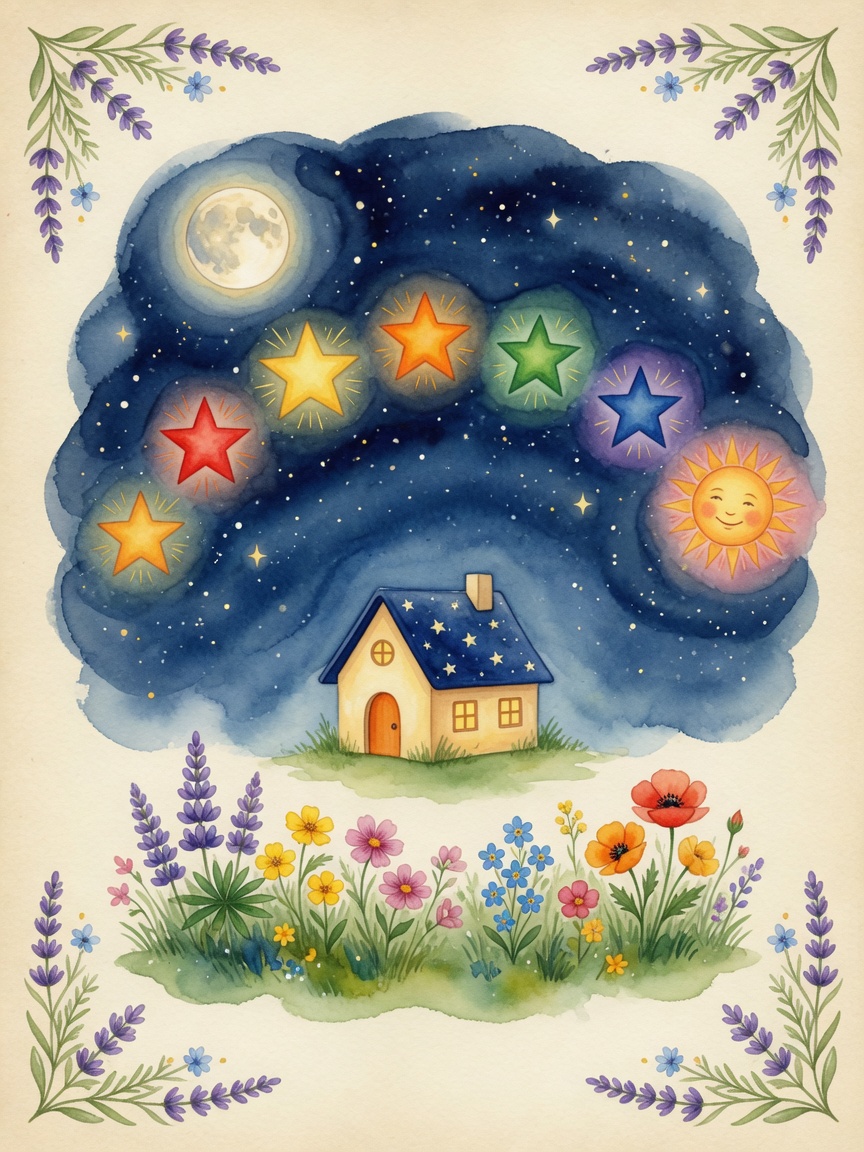
To give the child the picture behind the family’s week: that each day carries the name, color, and mood of one of the seven wandering lights the old world watched — Moon, Mars, Mercury, Jupiter, Venus, Saturn, and Sun.
This is not astronomy yet. It is rhythm, story, and belonging: the week as a round of seven friends who each visit in turn.
By age
Littles (3–6): the color of the day, the candle, and the morning line are the whole lesson. They will learn the week the way they learn a song.
Olders (7+): learn the day names in English and their planet-gods’ stories, find the evening star and the Moon in the real sky, and copy the seven names in their seven colors.
Materials
- Seven cloths or ribbons in the day colors: violet, red, yellow, orange, green, blue, gold
- The weekly rhythm chart from This Week
- A candle for the morning verse
- Watercolors in the seven day colors
Opening Verse
Seven lights walk through the sky,
Slow and faithful, low and high,
Each one gives a day its name —
No two days are quite the same.
The Great Picture
Tell it simply, perhaps under the evening sky:
Long ago, shepherds and sailors watched the night sky and saw that most stars stay in their places, like sleeping sheep. But seven lights wander: the golden Sun, the silver Moon, and five bright walkers — the ones we call Mercury, Venus, Mars, Jupiter, and Saturn.
People loved the seven wanderers so much that they gave each one a day. That is why the week is seven days long — it is the sky’s own rhythm, and we still live inside it.
Is This Astrology?
Teach this clearly: the day names come from astronomy first, mythology second, and astrology later wrapped symbolic meanings around the same planets.
Ancient people watched the sky and noticed seven visible lights that moved differently from the fixed stars: the Sun, the Moon, Mercury, Venus, Mars, Jupiter, and Saturn. They called them the wandering lights. The seven-day week grew around those seven sky bodies.
Then cultures gave those lights the names of gods from their own stories. The Romans used Mars, Mercury, Jupiter, Venus, and Saturn. In English, some Roman names were translated into Norse and Germanic names: Mars became Tiw or Tyr, Mercury became Woden or Odin, Jupiter became Thor, and Venus became Frigg or Freya.
Astrology uses the planets symbolically, but the weekday names themselves are better taught as ancient sky observation carried through language and myth. Our calendar still carries the old sky inside it.
Where The Names Come From
Sunday means Sun’s day.
Monday means Moon’s day.
Tuesday means Tiw’s day or Tyr’s day. Tiw/Tyr was linked with Mars, the red planet associated with courage, conflict, action, and strength.
Wednesday means Woden’s day or Odin’s day. Woden/Odin was linked with Mercury, the quick messenger planet of movement, words, travel, and exchange.
Thursday means Thor’s day. Thor was linked with Jupiter, the great bright planet associated with power, protection, thunder, largeness, and closing verse.
Friday means Frigg’s day or Freya’s day. Frigg/Freya was linked with Venus, the bright morning and evening star associated with beauty, love, harmony, and care.
Saturday keeps the old Roman name: Saturn’s day. Saturn was linked with time, order, boundaries, age, patience, and useful work.
The Seven Days
Monday — Moon — violet. Dreamy, inward, receptive. The day of water, bread, and gentle beginnings. Open Monday.
Tuesday — Mars — red. Strong, brave, active. The day of courage and good hard work. Open Tuesday.
Wednesday — Mercury — yellow. Quick, bright, talkative. The day of words, letters, and errands. Open Wednesday.
Thursday — Jupiter — orange. Generous, abundant, wide. The day of plenty and gratitude. Open Thursday.
Friday — Venus — green. Loving, beautiful, kind. The day of flowers, beauty, and the family feast. Open Friday.
Saturday — Saturn — blue. Old, wise, orderly. The day of real work and putting things right. Open Saturday.
Sunday — Sun — gold. Radiant, restful, whole. The day of light, rest, and the family together. Open Sunday.
Movement
Walk the week: lay the seven colored cloths in a big circle on the floor. Walk the circle slowly, saying each day’s name and mood; let the child stand on today and say the morning line: Today is … Its color is …
Then play "Which day am I?" — act a mood (brave stomping, dreamy floating, generous arms wide) and let the children guess the day.
Sky Watching
Once this week, go out at dusk and find two of the seven in the real sky: the Moon, and the bright evening star (Venus, when she is showing). Greet them by name.
That single moment — "we know you, we named a day after you" — joins the child’s week to the actual heavens, and it never quite leaves them.
Watercolor Painting
Over seven days (or one long afternoon for olders), paint seven small papers, one in each day’s color. Hang them in a row or a circle at child height: the child’s own week, painted by hand.
Spiritual Meaning
For the parent:
The planetary week gives children time with a face on it. Instead of an endless scroll of identical days, each morning arrives as a familiar guest with its own gift. Rhythm at this depth is security — and security is what young children convert into courage.
For the child, keep it simple:
The sky has seven wanderers. Each one gives us a day. The week is a round dance, and we know all the dancers.
Closing Verse
Moon and Mars and Mercury,
Jupiter and Venus free,
Saturn old and Sun so bright —
Thank you, seven, for day and night.
Extension Ideas
- Let each child claim a "birthday planet" — the day-light of the weekday they were born on.
- Olders: begin a simple Moon journal, drawing her shape each clear night for a month.
- Sing the days of the week to any folk tune at breakfast.
- Live the rhythm: the weekly dashboard is this lesson, practiced.
Parent Note
You do not need to believe anything about planets to use this — it is the actual origin of the seven-day week’s day-names, it is beautiful, and it works. Keep it a picture, not a doctrine.